Saturday, September 09, 2006

The Oracle: The Reason Why

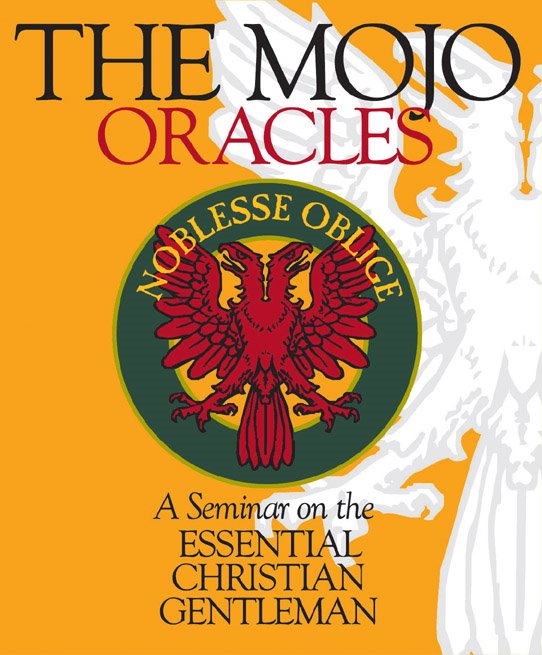
For those of you men who live out of town or perhaps don't see me with any regularity, this is the opportunity to spend a day going over a philosophy of manhood, relationships, and behavior unlike you have ever heard. The seemingly self-serving title of "The Oracle" was bestowed by young men coming in the night to ask questions about women. A few years back, one such gentlemen said that a seminar was in order. With his help and pressure was born....
THE MOJO ORACLES.

If you would like to come to town for it, let me know if you desire to use our guest rooms and we will see what we can do.


The Mojo Oracles are for Men only.
This year the seminar will be
Saturday, September 30, 2006
10:00 a.m. to 10:00 p.m.
at
THE BIG HAUS
325 North Polk, Moscow

Seminar Schedule: 10 a.m. to 6 p.m.
First Session: THE SUM OF ALL DESIRE
Are there basic reasons for everything every man does?
The first session explores the claim that we are all after something simply obvious. It is the underpinning of a rationally sound pursuit of being a man.
Sandwich lunch
Second Session: HIERARCHY & SUBLIMITY
As the prerequisite to honour and dignity, a philosophy of position has been lost in modern America. Regaining that mode of thought is essential to becoming the gentleman.
15 minute break
Third Session: NOBLESSE OBLIGE & THE SEVERITIES
The more masculine virtues of Honour, Dignity, Integrity, and Gravity are the oft ignored virtues, and are not friendly to the modern egalitarian outlook.
15 minute break
Fourth Session: THE MOJO
The Biblical understanding of the Attraction called “Woman” and the benefits of that understanding in resisting temptation and winning a wife.
15 minute break
Fifth Session: The Word of A GENTLEMAN
Gathered from the teachings of that penultimate gentleman, Philip Stanhope, Lord Chesterfield, and the Book of the Courtier by Count Balthazar Castiglione.
1 hour break
Roast Beast Dinner— 7:00
Attire: Casual
with, after dinner,
CIGARS

FIN — 10 p.m

COST:$50 —Make checks payable to The Big Haus Society
Cost covers a notebook with essential documents, lunch and dinner,
cigars (if you want one), and a certificate of attendance.
Send to: The Big Haus, 325 N. Polk, Moscow, Idaho 83843
Payment required in advance to secure a spot (which are limited).
Cancellations less than a week prior will only result in a refund of half the registration fee, due to cost of materials.
For more information
call Evan Wilson
at 882-8679 or 882-4885
or ewilson@turbonet.com

Thursday, September 07, 2006

You Are Quite Wrong

Mark 12
18 And Sad'ducees came to him, who say that there is no resurrection; and they asked him a question, saying, 19 "Teacher, Moses wrote for us that if a man's brother dies and leaves a wife, but leaves no child, the man must take the wife, and raise up children for his brother. 20 There were seven brothers; the first took a wife, and when he died left no children; 21 and the second took her, and died, leaving no children; and the third likewise; 22 and the seven left no children. Last of all the woman also died. 23 In the resurrection whose wife will she be? For the seven had her as wife."
24 Jesus said to them,
"Is not this why you are wrong,
that you know neither the scriptures
nor the power of God?
25 For when they rise from the dead, they neither marry nor are given in marriage, but are like angels in heaven. 26 And as for the dead being raised, have you not read in the book of Moses, in the passage about the bush, how God said to him,
`I am the God of Abraham, and the God of Isaac, and the God of Jacob'?
27 He is not God of the dead,
but of the living;
you are quite wrong."


This passage has interest to we Christians in the defense of the resurrection of the dead. "Gotcha," we say to the Sadducees. But it also has a side, but necessary, point concerning the Christ's cosmology. Christians, especially Arminians, like to move God to some place outside of Time in order to make classical theism fit with freedom of the will. There are basic problems with that move but this passage is not usually addressed in the argument. It should be.
If God is atemporal the Sadducee's point could be held and Christ's argument eviscerated. If the Sadducees or Christ knew of an atemporal place where God normally dwelt (and it seems today that Christians without a thought in their pretty heads know about God being "outside of Time") then the verse quoted by Christ would naturally be applied to God’s relationship with the patriarchs being “always” (from His atemporal vantage) and would not necessitate an “afterlife”. He, God, could be the God of the living because He is atemporally and consequently, permanently there in their living times. That would answer the verse speaking of the patriarch's "present" relationship with God and His with them. But Christ leans on the present tense of the remark as if their past state and now dead condition was of no consequence. But was not their past life a place that God could access in His atemporal dimension? So certainly would the Sadducees say if they knew of this silly notion. Christ is affirming that they are alive in the Now, in an afterlife synchronous with our earthly life, and only if that state is true can his appeal to the tense of the verse bear any weight. His relationships must claim the actuality of the beings related to and the Past and the Future have no "living" people and are not places that even exist in the relationships of God.

The oracle: Jesus Christ's view of the afterlife necessitates transcendent heavenlies that don't transcend "was, is, and will be".

After all, (and I mean "after"), Amen.

Wednesday, September 06, 2006

Of Mysteries Too Great for Mere Mortals

A miracle happened last night. My wife, the Amazing Missus, was preparing the Big Haus menu in the dining room as she listened, with one ear, to me reading aloud C. S Lewis' essay "Religion: Reality or Substitute" and leading a subsequent discussion in the living room. While it is a tremendous essay, all of that "smarty pants" talk faded to nothingness as reality ripped at the seams. She was writing, in her lovely, loupy, girl cursive, something she never usually writes. The words "frozen waffles" flowed from her mechanical pencil. And, (be still my heart), as the word "waffles" found graphite reality, from my lips, a room away, sprang the word "waffle".

Yes, dear friends and dearer enemies, this place, this Big Haus, is a vortex of arcana. Banshees roam the halls and leave unwashed kitchenware by the sink. Dang their filthy hides.

Saturday, September 02, 2006

The Nonesuch

All views that I have held have been questioned by minds greater and lesser. All views of mine, singly and severally, cannot put aside, as Lewis put it, "the logical exclusion of dispute".
Except for this one.
I was, west of the Azores and north of Trinidad, the cutest child ever born.
This pronouncement includes mine own children and, of course, yours.

Admittedly, in the spirit of Christian humility, I have not worn well. Each of you can feel free to consider yourself a better looking adult than the Oracle.

Sunday, August 27, 2006

Be Of Good Cheer

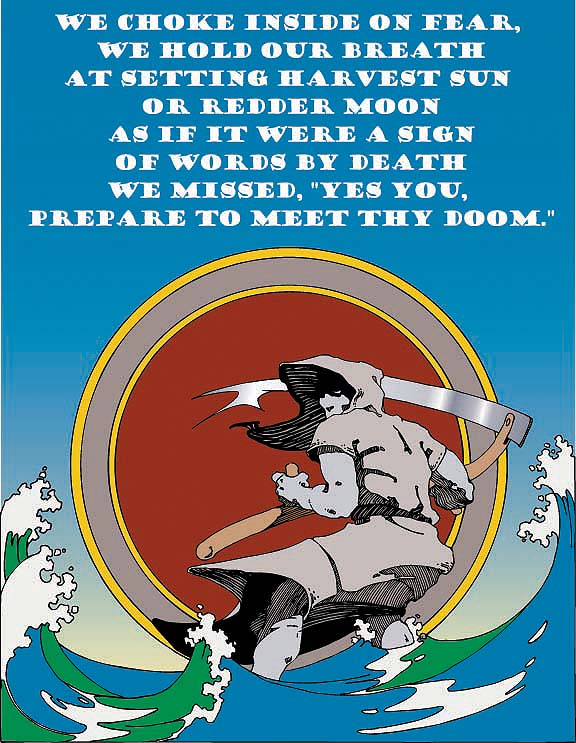
I found this old drawing I had done over twenty years ago and scanned it and colorized it.
I didn't just want to inscribe "Grim Reaper Comix" across the top so simple threatening poem would have to do.

Thursday, August 24, 2006

Off Mycale Peninsula

Gliding on forgiving green deeps,
Oars dipping in silent tattoo,
The warship to battle, it leaps
From seven to eleven knots. Crew,
Captain, and pace drum are urging—
The oarmen thunder with groaning—
Eleven knots tightens the turning—
Eleven knots from the sea foaming.
Rowers nigh dead lick salt from their lips,
The sweat and the lash lend life to their grips.
Calluses break driving water behind,
Mouths mutter curses on captain and kind.
Faster by far than death should arrive.
“Faster lads! Ramming speed! Drive!”


by Evan Wilson

The Heights

You have read of the calamity that fell on the saints of Big Haus!
Though from these Olympian heights (above my chamber door) Scotland fell, one Ginny Metzler, having read of my dirt, offered to share some of hers.
Praise be!
Here you see what was given, rubbing cheek to jowl with the survivors of the Beast.
1. dirt from the deserts east of Jericho
2. the Coliseum in Rome
3. salt crystals from the Dead Sea
and most importantly in our travails,
4. Scotland
On the far right sits a little jar with a clod in it picked from the wreckage of glass shards and dust swept into a trash can. It is now labelled "The Ruin of Scotland"

Wednesday, August 23, 2006

Them Changes

Aeons pass. Stuff happens.
A bird flew into my library the other day. Its delicate sensibilites could not seem to find the door which, as some of you know, is eight feet wide. The tussle that ensued involved two adults, a sheet, a broom, and a dustpan.
In the Annals of Nimrod, a mighty hunter before the Lord, it is said that the Oracle, wielding his dustpan (that he had named Landwaster), smote the beast until it fell from the heights and assumed room temperature. The wounded were then counted ere the trophies could be set up. The sheet in its efforts to entangle the beast had swept the dirt collection from its place on high. Down plummeted the flasks at 32 feet per second squared and Scotland the Brave smacked the glass on my desktop a ripe and juicy one. Scotland and its glass-walled home were smashed to atoms and the glass top to the desk went similarly but in larger pieces.
What you see before you is the desk awaiting its new transparent protection and it is being shared with you this day as, with the changing of the seasons, new stuff and old have been arranged thereon.
Of these articles, feel free to ask.

Monday, August 21, 2006

Till As Angels Be

We wouldn’t chase our souls apart unless
We died and wander’d up to Heaven’s height
Where should and shall that death make meaningless
These vows made only sacred in this life.

My mind walks o’er the years of you gone by,
Slows my step toward our passing’s parting,
Though I would run if in thy lap I die
In heaven, to Heaven’s apt arriving.

A poem to my wife
on our anniversary
28 years
August 12, 2006

Sunday, August 20, 2006

Sin: Excuse or Escape

A creation subject to futility and sin since the Fall has made up our minds for us. We face the travails of the calamitous in our lives and the task is to arrange it better. The guilt of sin is one such pain and man has either to brainwash himself into thinking it doesn't affect him that much or to flee from it outright. Of course the Christian view ought to be flight, escape, resistence through the grace of our Saviour but hidden in our philosophies are basic life defining principles that tempt us to excuse rather than escape.

The positions of determinism and free will each carry that virus. Determinism has the excuse ready made. While those that claim the view affirm that they alone are guilty of sin they have, hanging behind the scenes the strong affirmation that they are not the cause of anything. All excuses attempt to remove causality from the self because cause, to the degree causal, is responsibility. Even within that theology there is the admission that this principle is true. Just look at the means that are used to claim that we can not take credit for our faith. We all "seem" to exercise faith unto Life. The determinist says that those within the free will camp are trusting in a faith that, to their mind, is their own and hence a work. And, they say, we know we are not saved by works lest any man should boast. How do they make this "seeming" self originated faith not your own? God causes it and therefore only God should be credited. So you see, the determinist agrees that the truly causal (regardless of "Seeming") is responsible. The question naturally arises that, if God causes faith and sin (and He is 100% causal to both according to the determinist), why am I credited for sin and denied it for faith?

As an aside, if faith is freed from being a work by the causality of God, how then can even a bona fide work, claimed as a work by the individual performing it, be a work?

The free will position, while not in an of itself an excuse for sin holds temptations as well. It acknowledges the individual's autonomy. For the sinful agent, their sin was their autonomous wanting brought to life. The lordship of the self is easily seduced into being the only lord. God can be put at a distance from which the penalty of sin is less likely to occur. This can be a physical distance (like deism), a strength distance (like paganism), an informational distance (like process theology) , or an emotional distance (like agnosticism). Freedom of the will bears its own guilt but if the adherent of the position wants to dwell in the comfort of arranging his own conscience with more local justification, he just needs to cease seeing the God of the Bible as close, personal, concerned, involved, opinionated, and, without a doubt, powerful.

The oracle: Let us measure our lives less by the benefits of our philosophies for in them can hide excuses, our hiding places. Let us give ourselve more to the benefits of God's grace, for in it is our escape from the guilt of sin and the power of sin.

Tuesday, August 15, 2006

Define Sovereign

When someone says that God is Sovereign, any Christian worthy of the name finds himself agreeing but at the same time feels that the speaker is using code for something else. It is largely because the idea of YHWH, maker of Heaven and Earth, being sovereign is too obvious to be that speaker's only motivation. He who intones that "God is sovereign" is "up to" something. The word "sovereign" means "rule" and, of course, God does... all things. But the person that was belaboring the obvious was not saying that God rules, he was saying that God exercised a certain kind of rule, that of exhaustive sovereignty. He is saying that God is an Autocrat (all decision falls to Him) versus a Monarch (the highest and ultimate judge of all decisions).

The foregoing is an example of the infamous "boa constrictor" argument. This a form of argument is one in which a concept is uttered in terms with which everyone in the audience will agree (the loose loops of the snake) and once everyone assents to it, applying it narrowly, presuming on the agreement of the audience (constricting the coils). It will either be that the loose or the tight use is being misdefined. In this case, the tight is the erroneous usage.
They say, "God rules."
We say, "yeah, you betcha."
They say "So you agree that God is in exhaustive control and has decreed all things."
We say "Nope."

The question before Christians regarding the Sovereign of the Universe is His method or kind or extent of rule. And the debate is narrower than we think. The nature of rule is that there be two (minimum) participants, that which rules and that which is ruled. They don't have to be outside an individual as in the mind ruling the body but they must be discrete. The discreteness is present only if there is a real potential of regard and disregard of the ruler. The ruled may not merely be the extension of the will of the ruler or there is no other will for the ruler to rule. If God's governance is presumed to be an exhaustive autocracy (in which nothing occurs but the will of the ruler) there is no actuality to the existence of the party called "the ruled". We know that in ourselves, that the closer we get to an absolute submission to our wills, the more closely we are able to define that which is our self. If there is an absolute and exhaustive submission to the will of God, nothing exists but Himself. The apparent diversity of creation would be merely the presence of God. It is pantheism ( "God is everything and everything is God … the world is either identical with God or in some way a self-expression of his nature"). Consequently, exhaustive divine sovereignty is not sovereignty at all. Only that which grants (by whatever method) an encounter with possible obedience and disobedience can claim to rule. God rules like all rulers rule. He has not exhaustive decision but exhaustive imperium, the unquestionable ability to reward and punish all things. His absolute ability to punish and reward all that is in His creation is the arena of sovereignty. The question before Christians is between, and the ratio between, that which He causes and that which He rules.

Monday, August 14, 2006

Define Justice

Justice is when an action occurs in an arena over which an agent has an established hierarchic governance and, regarding which action, the ruling agent has previously expressed its will to the citizens of that arena, said agent awards benefit or applies detriment to the actor discovered to be responsible in a measure proportioned to that actor's contribution and intention of cause.

Is it justice if an action measured is only possible?
Is it justice if the less measures the greater?
Is it justice if an agent not governing that arena executes a decision?
Is it justice if the actors are unaware of the ruler's will?
Is it justice if the ruler does not consider responsibility?
Is it justice if causality is not the measure of responsibility?
Is it justice if measure of responsible cause does not include degree of intention?


If I am wrong and one hundred percent causal for the above statement, by what definition of justice could I be blamed?

Friday, August 11, 2006

The Glory of Desk Drawers

Desk drawers are a sanctuary. Things which had meaning and lost it need a place to hide until they can regain their meaning. What are they hiding from? Some woman, probably a wife or mother, scouring a house looking for things to sell in a yard sale. Yard sales are the liturgy and sacrament offered up to the Great Ancient Anatolian Goddess "Shopping" who has said repeatedly through her foul, eunuch priesthood that someday, somewhere everything you can possibly buy, you can buy for 25 cents. Think of these women as the Saturday Morning Maenads. But I digress. Desk drawers are partially designed to be outside a woman's sight. They blend. When shut, they look tidy and neat. All the while, inside their shallow deep and dark recesses, a gathering of the important stuff that will be the joy of many grandchildren after your death. This is because stuff cannot speak for itself. Men know that stuff in drawers has lost, if only temporarily, its meaning and cannot lay about in the open. The religious fervor of Woman would ignore your entreaties, look upon its pointlessness, and consign it to a bin, a bag, or box labeled "yard sale". There is no appeal. If she finds something wandering about after it has been consigned, she may choose to serve the commands of this G.A.A.G.S. rather then St. Paul's teaching regarding the withholding of connubial bliss (he was against it). Rather than risk this destructive force in a marriage, a man should set up these "drawers of refuge" in strategic spots around his domicile.
If any of my readers are women and are suppliants of G.A.A.G.S. , today you will be exposed to a telling victory in the Oracle's application of his "drawers of refuge". I was rummaging in one (no other word is allowed for this practice) and, lo and behold, I came up with those two thingies pictured above. Defenseless stuff at its finest. You women are probably thinking, "Where were they hiding?" On the left (grid is at .25 inch) is a bronze coin from Judea circa 103-76 B.C. issued by the Hasmonean king Alexander Jannaeus while on the right is a bronze coin from Judea issued at the time of Festus, the Roman governor before whom St. Paul gave his defense. There you go. Antiquity in a drawer in North Idaho, hidden, because women walk the Earth.

Wednesday, August 09, 2006

If You Seek, You Find

Your saving and living faith is not merely about the sum and truth of that which you believe. It is also about how you got there.
"And without faith it is impossible to please him.
For whoever would draw near to God must believe that he exists
and that he rewards those who seek him." Hebrews 11:6

One of the key elements of faith, in fact its very beginning, is to believe that God is there and He is benevolent to those who seek Him. No one but one's self can accomplish this. No ecclesiastical institution nor historic compendium of truth can replace the absence of it for an individual. God wants to be sought. He rewards those that do.
His purpose was clear as early as the dividing of the nations as He says through Saint Paul at Athens,
"And he made from one every nation of men
to live on all the face of the earth,
having determined allotted periods
and the boundaries of their habitation,
that they should seek God, in the hope
that they might feel after him and find him."

There is a Club Christianity which you can join with the half-faith mentioned at the first. You can become a member in good standing by mere regularity of attendance at services and assenting to certain facts about God. If surrounded by a culture that applauds this as conversion, God (and I mean this) help you. Half of your faith is still missing. When did you first devote yourself to knowing Him? When did your upbringing, if it were in a Christian home, stop being the end of your faith and start being a signpost. Do you revel in all the revelation of God, from Nature to Scripture? Do your words tell a tale, by prayer, praise, and testimony, of your pursuit of God. Do you seek?

If you do not seek Him one wonders if you actually believe He exists and is gracious. Without having asked and answered the questions about God, sin, and salvation how could your faith ever expect to be "the assurance of things hoped for, the conviction of things not seen"?

"Seek first the kingdom of God."
"He who has ears to hear, let him hear."

Tuesday, August 08, 2006

Maduro Dance

The off white lines wear grey in early twilight
And dance the measure played. They swing in wreathes
Down the floor of Brahman with moves polite
Scenting all the Atman that I can breathe.
Warm pirouettes come kiss my lips and leap
To warm my soul; tone my eye with amber.
Golden hearts are thus refined. Drawing deep
On the heat of slow consuming, cambered
Coals while hands untouched by the warmth of such
Ecstatic calm, damn contentment and damn
This art, this joy. They say,‘You dance too much!’
But dignity is out of reach to them.
The step, the pace has certain height and grace,
A hint of Spanish with Virginia laced.


by Evan Wilson

Monday, August 07, 2006

Christendom versus Christianity

No, it is not a very original title but the subject has been on my mind. Many would agree with these two categories but they would probably draw the line at a different place than I. I draw it between personal darkness and personal light. There is a sizeable majority of active, sincere (meaning not nominal) Christians who do not seem to be changed by the Holy Spirit. Worse, there are ministries which, seeing where the demographics of "size success" abide, cater their doctrines and their words to attract and keep that majority. That majority becomes the history of the Church. That population sends its generations to seminary. There is more of practical unregenerating belief in the Church than regenerating belief.

Of course, that majority does not know the Lord Jesus Christ and has not been set free from sin. These ministries that speak to them can be liberal and say there is no sin (except racism or believing in sin) but they are generally not successful because they give insufficient religious perks and are hard to distinguish from the secular. The successful church or ministry will be conservative. They try, with the law and church culture, to tidy up these church-going, creed-believers so that a vague similarity to the ethics of Jesus might appear, at least in their brochures. It is whitewash for the "visible church". As an example see any Christian college's PR glossy and then visit the lives of the smiling students, let alone the homes of the teachers. I consider this Christendom infidel, not because it doesn't have faith but because it believes in its belief, like the Seven Sons of the High Priest Sceva in "Jesus whom Paul preaches." My years of observation has convinced me, with no residual doubt, of Our Lord's words, "Narrow is the way that leads to life and those that find it are few."

Christendom plays at being Christian unsuccessfully but quite successfully relives the foibles of Israel. Israel was an unregenerate nation which the Living God had chosen and had controlled through the Law. They trusted these deceptive words "This is the temple of the Lord, the temple of the Lord". That is exactly what the Christian culture mongers are seeking (be they the "keep my kids innocent" neo-agrarians or moralizing, political "prayer in public schools" activists or the Oxbridge medieval protestants engaged in heavy petting with Apostacy). Like Israel, they trust in their history, their liturgy, their buildings, their priesthood, their superstitious sacramental magic, and their social affectations. Yes, it is a "sign and a wonder", an empire which very busy men have built. It must be large, complete, and compelling. It has to make people think of themselves as Christians without personally "calling on the name of the Lord. It has to replace the Gift of God.

The Old Covenant was a needful means of running an unregenerate people with a modicum of external order. The New Covenant is making a different sort of person, ordered internally by the Holy Spirit. If you get handed a "Christian" culture by the leaders of your particular movement, you are joining the Old as Israel not the New in Christ, a shadow not a substance, a playtime of childish ways not maturity, law not grace, Christendom not the Kingdom of Our Lord and Christ. The Old Covenant was just that shallow. But the unredeemed want the shallow because they can touch it. They like their covenant reality to be a large and bumpy objectivity. The blind need it thus that they might feel their way along. They can believe that the church believes the right things because being blind, they have to trust someone else to post braille signposts along the way. They want the church to stand between them and God much like Moses stood between God and the people. But the writer of Hebrews says, "For you have not come to what may be touched." True Christianity is lived out by those for whom the Holy Spirit has written His culture on their hearts. Christianity is the subjectivity of a covenant and the covenant is the promise of a wonderous miracle of subjective change.


There can be splendor in a man made culture. It fills our aesthetic needs and desire for order but it is no guide to successful Christian living. If righteousness were through the law or any outside social manipulation we would have no need for grace. Some things must be your own, personally, as in the phrase "every one who calls on the name of the Lord will be saved." Are you one of these? Or do you have more than one "degree of separation" between you and God? There is a difference in metaphysical condition between the man or woman who believes that others believe correctly and those men and women who have believed. The first group wishes to have and needs to have the church they believe, believe correctly and to tell them what is good and how to live. The second have looked into the face of God, unveiled, and were changed. Are you someone who has found the narrow door or are you marching lockstep down a very broad highway to Destruction, with the comforting presence of the rest of Christendom.

The oracle: Christianity and the New Covenant is individual with the church as its collateral effect. It is not the Church with its collateral dictates to the individual.

On the temptation of Christendom, or any part of it, to dictate a culture, C.S. Lewis in Lilies That Fester:
"Anything transcendental or spiritual, or even anything very strongly ethical, in its pretensions is dangerous and encourages it to meddle with our private lives."

"The higher the pretensions of our rulers are, the more meddlesome and impertinent their rule is likely to be and the more the thing in whose name they rule will be defiled. The highest things have the most precarious foothold in our nature. By making sanctity or culture a moyen de parvenir you help to drive them out of the world."

And if you were always suspicious of Lewis, here is St. Paul.
II Corinthians 3
5 Not that we are competent of ourselves to claim anything as coming from us; our competence is from God, 6 who has made us competent to be ministers of a new covenant, not in a written code but in the Spirit; for the written code kills, but the Spirit gives life. 7 Now if the dispensation of death, carved in letters on stone, came with such splendor that the Israelites could not look at Moses' face because of its brightness, fading as this was, 8 will not the dispensation of the Spirit be attended with greater splendor? 9 For if there was splendor in the dispensation of condemnation, the dispensation of righteousness must far exceed it in splendor. 10 Indeed, in this case, what once had splendor has come to have no splendor at all, because of the splendor that surpasses it. 11 For if what faded away came with splendor, what is permanent must have much more splendor. 12 Since we have such a hope, we are very bold, 13 not like Moses, who put a veil over his face so that the Israelites might not see the end of the fading splendor. 14 But their minds were hardened; for to this day, when they read the old covenant, that same veil remains unlifted, because only through Christ is it taken away. 15 Yes, to this day whenever Moses is read a veil lies over their minds; 16 but when a man turns to the Lord the veil is removed. 17 Now the Lord is the Spirit, and where the Spirit of the Lord is, there is freedom. 18 And we all, with unveiled face, beholding the glory of the Lord, are being changed into his likeness from one degree of glory to another; for this comes from the Lord who is the Spirit.

Wednesday, August 02, 2006

Misericorde

Lifeless bodies lying, lay with living
Men, torn and suff’ring still. A battle done
But the dying beat back Black Death, hov’ring
In his sorties for the slain. Patience won
More warriors in the slow embrace of pain
Than the reaping instant of the pitched war.
On the field limbs are moving not. They’ve lain,
A tangled knot and mass of meat, no more
A memory of the thundering host. Red
Armour, bent before the killing blows, seeps
Into the mud and knights, with those they led,
Sink rusting into Hell, to dust, to sleep.
But cries, weak cries, above the gore and dirt
That was a proud and standing man at arms,
Lift pleas, Dear God!, to aid or end the hurt.
The different words in different tongue charms
With partial pity an indifferent knight
Who passed. The dagger in his hand had left
The coup de grace till now. His sword and fight
Was why such dying harvest was bereft
Of most of life. A cruel sight to leave.
Quiet parts the pleading lips as breast bends
To feel the steel of Death. The Fates must weave,
Alas, but thus make mercy and amends.

by Evan Wilson

Tuesday, August 01, 2006

An Illustration

Body odor is hard to discern when it is your own. You are happy with your choices of hygiene and you will not notice your pungency without shoving your face in your armpit. You are at peace. Others are not so lucky. It is your odor and their nose. They don't need to put their face in your armpit. They merely need to walk by or step into an enclosed place with you. Soon they are dreading the "fellowship" you offer after church. "Someone," they say gossiping like the Philistine, "must tell you." They certainly should be braver but they are not. They should, in a manly way, walk up to you and declare to the ears that which the nose lacks. "Sir, you are offensive to all that breathes. Without breath we die, but sir, with it we are sore wounded until death may be preferred." Such would the brave man say to his, now, ex-friend. Instead, less brave, he leaves an unsigned note in the pages of the odiferous friend's KJV (the stinky are often sticklers).
Once this note is found and read, the comfort of the pungent is disturbed. The borders of his life have been breached. The proverbial rock with a note has been bunged through his window. Is it a psyops attack of enemies? "You stink" when you don't can be viewed as an attempted misdirection of your efforts in ruling your fief. Is it the fearful admonition of friends who wish you to remedy something that affects them? Both are likely stories as stories go. The choice between them will tell another story, that of self assessment. Most of us, I think, are insecure about our attempts to be physically pleasing and would naturally understand that our self-comfort has misled us again. We may quickly develop into a three-shower-a-day obsessive compulsive. It takes a mighty proud man to be so confident of his hygiene that he feels free to consider the note-writer an enemy whose efforts were an obviously flawed attempt on the citadel of a kingdom wonderfully run.
Do they not know that this is how all men should smell?

There is an irritation ratio that could be discerned. In both stories it is a negative act to lob a unsigned missive into another's life commenting on a failing and it is a negative condition to stink. How annoyed we are with which, is the ratio we find defining our souls. Does my annoyance with the unknown writer predominate? Or my failure to clean myself sufficiently?
Sometimes, when the planets align, the stink is real and the enemies are real. This ratchets up the confusion in dealing. The foul one easily sees the animus of the commentary and is tempted to consign the whole proceeding to motives unconnected with his stench. Others, friends, see that an enemy spoke the needful first and was rejected so they hurriedly scratch out a note and file it in the KJV . "No really, I mean this, you do stink. This is not from the previous anonymous writer." "Sure its not," says the offensive to himself and others who have grown comfortable with a certain level of greenish miasma in the places they gather. This is not a circumstance which will get the stinking to stop anytime soon. Some give up and avoid. Some try to find new ways to speak to the stink. They try directly, as the brave should have done but it is too late. The stinkers have developed a view. They have addressed the concept of stinking thoroughly because they defended against enemies. As for the enemies, damn them. For the olfactorily offended, they need to realize that noses are merely the evolutionary residue (like the appendix) of radical anabaptist pietism. And our friends, we will make and sell a bacterial cocktail that will, when applied to your sweaty areas, grow into a New Wave of Wafting Greatness that Will Sweep the Infidel Nosiness Down to the Pit. And we will also need to develop something for our watering eyes.

Thursday, July 27, 2006

Is There a Problem?

Suppose someone calls the police and, disguising their voice and refusing to give their name, lets a detective know of a crime committed. It is called a tip. The police like it when it happens. The anonymity protects those in the know to sufficiently to allay their fears of being embroiled more than they wish. The tipster usually has some criminal connection or guilt that they would rather not discuss with the police. That said, the tipster has information the police need to and should want to know because it gives the forces of righteousness something to go on, a task and direction to pursue. Of course, anonymous testimony would and should never be admissible in court but the tip is not a trial. For the police to treat the tipster as if some unconstitutional blasphemy had occurred is to confuse categories.
"You must confront the alleged mobster yourself first, sir," replied the flatfoot.
"Geez, copper! He'll kill me!" sez the garbled voice.
"He has a right to face his accuser, son. And be sure to take all witnesses against the accused with you. It wouldn't be grave justice in this great country of ours if you didn't."
"(click)"

When a conversation occurs in which I am informed by "anonymous" of some bad action (either of mine own or some others) I have two choices:
1] I can disallow the charge on grounds afforded to me in formal courts, behaving like all actions of this nature were essentially formal. The generic guilt of tipsters is cause enough.
2] I can thank the vague voice and promise to investigate, the guilt of the tipster notwithstanding as the tip refers to something with which I should be very concerned.
The first is that of a martinet. He has confused low things for high things (himself first on the list) and has claimed the bureaucratic dignities of the high as a buffer.
(\mar-t'n-ET\, noun: A strict disciplinarian. One who lays stress on a rigid adherence to the details of forms and methods.)
The second is a virtue called humility of a little practiced Near Eastern religion called Christianity.

But what if the claims are outlandish? What, O Oracle, what if it were about YOU?!
I don't imagine that any of my sins are reposited in my soul without a force field of significant justification surrounding them. My friends won't say anything because they either believe my justification or want to remain my friends. My enemies, whose eyesight regarding my failings is acute and is likely no more tainted with animus then my justification is tainted with self love, they wish, for whatever foul motive, to bring me to my knees. Odd, if I sin, it is just where I should be. They are Assyria, more wicked than Israel by far but God was being faithful to the Jews by reminding them of righteousness at the hands of the Gentile.
They, the anonymous Assyrian, is an ample target for scorn but I, the chosen, the Israelite, am gifted at neck stiffening.

Is knowing a name all so important when we are trying to hear the Lord's direction and correction? If our spirit is being admonished we should be thankful that our spirit is alive enough to hear the admonishment and not so closed that it demands a name be attached. Would the discovery that my accuser is a sinner himself (as is probable) merely relieve my curiousity and send me before God to examine my conscience? No, it would be added justification that my desire not to listen would be confirmed.

Anonymous accusation is a test of our humility. This is no institutional trial before our peers (they would need to prove the claim) but a trial of our souls before our selves (for we can know, without awaiting the formalities of trial, the proof).

We must not wait until our madness is restrained by a speaking ass.

Wednesday, July 26, 2006

The Grace That Was Alexa

On the death of my niece, Alexa Grace Wilson

And should we say this child with life as such
Must be bright with light and sight to bless?
And should we pray in tears o’er trifles much,
Define the best and love th’unworthy less?
Now would this race of earthbound men refuse
To grant e’en fifteen quiet months below
And would we trace and speed the minutes? Muse
Upon here numbered mourning hearts and throw
Your minds into the time that calls us all.
Wonder, we with sight and ear, if at Death
We will draw friends to compass such a hall
That here at fifteen months appear. Her breath,
Bless’d, unbreathed now, taught the hearts of men
In better ways than many, without Grace,
Amen.


by Evan Wilson

The Code of the Futilitarian

Live as to enjoy earth today.
Live today as to enjoy heaven later.
Live as to die inbetween.

There is nothing better for a man to do.

Friday, July 21, 2006

Of Peace and Glory

There have been men like Cyrus the Great, the Emperor Trajan, William the Conqueror, and Saladin, whose exploits warm your heart as they marched their legions along a bloody path to peace.

And then there are people like the 7th Earl of Cardigan, James Thomas Lord Brudenell. What a world-without-end idiot!

The wonderful lessons of war stand close to the disciplines. While some gloried few learn that they are called to a greater mandate, most will learn that they have stepped too far.

Bully Beer

Lift high and hail the amber glass
Or darker still, the stout.
Nectar distilled of barley grass
And hops to stop about.
Salute one time the brewer's men
They've labored weeks to this.
And toast the one who bought this round
Bestowing blessed bliss.
And thank your God for life and friends
Whose hints of heaven cheer,
Good conversation without end
In warmth with bully beer.

by Evan Wilson

Tuesday, July 18, 2006

Quo Vadis

If you are a Christian, the Mosaic Law ought to be abolished in your life. The Law was used, according to Galatians, as a custodian for the unregenerate, as the world, filled with the unregenerate, awaited the advent of Christ. The world's history can be a metaphor for the progress of your own soul.
You began in...
1. A state of innocence
2. The Law came
3. Sin came to life
4. You died.
5. Because you are dead, more and more Law is added in order to keep you in custody.
6. "Who shall deliver you from this body of death?"
7. You were set free from the Law and Sin and called to Righteousness by Jesus Christ
8. You, perhaps, insulted the work of Christ by turning back to the Law.
9. "What shall deliver you from this second death?"
10. Oh, I dunno, maybe it is in the Book of Galatians.

The claim for the need of Law in a Christian's life carries with it two errors.

Correction #1: First, a factual mistake of identity. If someone is in Christ and in His grace they don't need it. "Sin shall have no dominion over you for you are not under law but under grace."

Correction #2: The second error is more of an "oops", rhetorical/PR blunder. The persistent claim that Christians do need the Law, far from defining the deeper walk club, defines the user as "slaves" not "sons", living in "shadows" not "substance". The more Old Covenant you apply, the less valid your claim on the New Covenant. This error is based in the logic sprung from the definitions of the two covenants. The Old is external law under which a person dies and the New is internal law by which a person lives. This, folks, is their difference and their place of contention. One cannot be a "strong" Christian and be under the Law. Such a Christian has "nullified" the grace of God. If under the Law, you are either claiming you are a Christian that is morally retarded, internally prepared for the impious, and needing to be led around by a keeper or... you are not a Christian at all. The presence of Law claims one thing, that the person cannot be trusted to naturally live in accordance with Holiness. It says, "Hey Jesus, thanks for nothing!"

What place is there for those under the Law? They can fit in with the Mormons nicely and they'll always look better than the profligate. They get all those heady benefits of making their own religion and the gratification of insisting on it for others. Luckily "Jesus" and "Christian" are not copyright which will make what they design look more like the real thing for the other "spiritually challenged". They'll get a lot of help out of church history because their kind of spiritual retardation has been prevelent in many of the more famous chuckleheads. They'll feel like they are part of something big and lasting, you know, like "falling away from grace"(very popular over the last two millenia). It would be nice to have the help of Jesus and His Spirit but "This persuasion is not from Him who calls you." So, tragically, they will still look worse than those for whom "born from above"and "fruit of the Spirit" meant something.

Jeremiah 31:31-34 "Behold, the days are coming, says the LORD, when I will make a new covenant with the house of Israel and the house of Judah, not like the covenant which I made with their fathers when I took them by the hand to bring them out of the land of Egypt, my covenant which they broke, though I was their husband, says the LORD. But this is the covenant which I will make with the house of Israel after those days, says the LORD: I will put my law within them, and I will write it upon their hearts; and I will be their God, and they shall be my people. And no longer shall each man teach his neighbor and each his brother, saying, `Know the LORD,' for they shall all know me, from the least of them to the greatest, says the LORD; for I will forgive their iniquity, and I will remember their sin no more."

The oracle is this: The less restrained a person is internally, the more restrained they will need to be externally. Go figure.

Sunday, July 16, 2006

Let Me Think

Of my life,
on having memories of the Anne Arundel County Library
whose children's section was in the basement
down a worn, colonial staircase.

On narrow step and ever down,
My own small feet descend and rise,
Small arms filled full with pictures bound
In blessed books for children eyes.
I searched for those, an alibi
For looking, longing at my dreams
Which held a story in this wise;
To sit in quiet thought unseen.

But child life is life around
Many things of play. It tries
To, sneering, snatch away what's found
By quiet wits. They criticize
My daemon, and to exorcise,
Build games and tawdry toys between,
But pictures still within me rise
To sit in quiet thought unseen.

With age words were with pictures crowned
Without the drawings loved and prized
And hid my passion in the town
Of souls. I should apologize
To those who meanly memorized
The plays of sport and business teams.
I'm a cripple man, black-avised
To sit in quiet thought unseen.

I do not tempt, evangelize
These latent ways, my creed serene
But cross myself and catechize
To sit in quiet thought unseen.


by Evan Wilson

Saturday, July 15, 2006

Buying, Selling, and Getting Gain


Perhaps because I thought these things out in your company or perhaps it is merely the curse of thinking too much while being a graphic designer with a Kinkos nearby, but, for whatever reason, you are looking at the product resulting from my interest in the social philosophies of gentlemen and ladies.
Yes, now you can have these available for easy reference in your own pudgy hands.

The posters are 11x17 on card stock for $10 each.
The booklets are sixteen pages of tightly packed, perfunctory pith for $6 each.
Go to
http://thebighaus.com/html/contact.htm
for the means of contacting us with any requests.
Checks can be made out to: Evan Wilson
(Throw in $3-$5 for mailing if you are overwhelmed by the opportunity, ignoring any rational objection made by your spouse, and just send in an order.)

For the curious: The background is the carpet in my bedroom.
For the critical: perfunctory \pur-FUNGK-tuh-ree\, adjective:
1. Done merely to carry out a duty; performed mechanically or routinely.
2. Lacking interest, care, or enthusiasm; indifferent.

Thursday, July 13, 2006

Petty Kingdoms, Poorly Run

"And he said to him, `Well done, good servant! Because you have been faithful in a very little, you shall have authority over ten cities.'"
Our lives are kingdoms held in fee. While few of us are or ever will be truly great (I have a corner lot in Moscow, Idaho and Alexander was dead by the time he was my age) we have to stand up and recognize that we are not animals. Our humanity is in our Will, our Governance, and the extent of our internal Civilization. In fact, though we are smallish kingdoms, our self knowledge has come to us accurately when it knows where is the border of our realm and the peace of the life inside it. I meditate on this when speaking to others who can't seem to find the simplest wisdom by which they could govern better.
I think, "You don't do "You" very well, do you? Maybe if you had less in Life, you could do it better.
"Every one to whom much is given, of him will much be required"
We have been given humanity. It is a station, a dignity a little less than the gods. How have we scribed out the ways and orders of our lives? How have we governed? The rest of humanity watches and measures the joy of our citizens, the contentment of our queens, and the peace of our souls. Are they thinking that perhaps we were given too much?

Wednesday, July 12, 2006

Monday, July 10, 2006

It Has To Be Said

OOOOh! The stars in heaven and all the saints in heaven preserve us! Aiiiieeee! Italy! Beats ! France!
OH MY! OH MY! OH MY! OH MY!

(yawn)
Yes, I know they are great athletes but so are the cannibals that chase you through the jungle.

Tuesday, July 04, 2006

Oh Yeah, it is the Fourth of July

Having a cookout. Ribs, beans, fixin's, friends, fireworks. The usual. There is a slight difference that I have with my fellow traveling evangelicals. They want to have the current citizen remember the sanctity of the Founders to inspire a better patriotism. I want the current citizen to be a patriot for the country as it stands today. If they think at all of the Founders, they should briefly consign such Founder's souls to a place of unremitting torment where the worm dieth not.
For the easily confused"
1. The Founders were not patriots, they were sinful rebels against their nation's king and God's anointed.
2. You can be a patriot, but love it for what it is today with today's authorities.
3. Putting a powdered wig on an evil man will not make him godly.
4., Our later benefit (financially and politically) is a crass reason to stand the teaching of Christ and His apostles on its head.
5. "Therefore he who resists the authorities resists what God has appointed, and those who resist will incur judgment." Romans 13:2

Abject Again

What was I thinking? It should have been:
1. The Self is the region defined by Feeling.
(Wait a year)
2. Plus the government thereof.
(another year)
3. Any questions before we proceed?
(Two years this time because some people are shy)
4. So on and so forth....

Any more on the Self, the Will, etc. will await your personal visit to the Halls of Power (The Big Haus) where any "huh?" can be immediately responded to.

Remember that the other oracles (Delphi, Siwa Oasis, Sibyl) were notoriously obtuse. Tell me I am not qualified.

Monday, July 03, 2006

An Idea: Knowledge of the Will

The Self is defined to us in contradistinction to the Other by encountering Feeling. I am initially the extent of my Feeling and the extent of Me grows as I exercise Will to arrange my life according to my valuation of those Feelings.
That said (whether of not it finds agreement in you), it would be impossible for another sentient agent to obtain certainty of those valuations and thereby "know" which decision my Self will make necessarily. Why is this impossible? Valuation of Feeling is made in the Self from the vantage point that only that Self occupies. Another agent (by some magic) might be able to link up with my Feeling in some objective accuracy and even know every aspect of vantage that my Self brings to that Feeling. But here is the rub. The other agent cannot "only" see my Feelings from my vantage, their own vantage is inexorably tied to it. I value my Feeling without the addition of the Other agent's vantage. The Other agent could only hope to gain the true vantage I have by completely relinquishing their own additional vantage. If they did this, they would have become me for I am the agent that Feels and values from this vantage and this vantage alone. Such is the Self.

But freedom from outside knowledge of my valuation's necessity does not free the Self from the accusation of valuing and deciding in some mechanistic necessity. How is the Self free? It could be that merely its autonomy can be called free. No one else but the Self was involved in the procedure. This seems insufficient as my valuations might be necessary, given my vantage and memories of earlier vantages. Stated thus , "Anyone who stood on this spot with this history and felt thus will necessarily value said feeling as X and decide predictably." We would be the sum of some mathematical complexity running down through history from the Creation. Is there an aspect of Feeling and or Valuation that may step aside from the mathematical sum? If there is an answer it need not be for all decisions (as we know that many of our decisions are made according to the autopilot) but only needs be shown possible for one decision.

I will suggest incoherence. There may be a True portent in a given Feeling (be it Pain or Pleasure) which the feeling agent may not be privy to. It will be his valuation that grants that Feeling the working intensity on which his decision stands. It will be felt subjectively. The key word is "felt". A Feeling is an assault on a sense receptor which does not have the capability of rigid accuracy but comes in with a possible range of sense benefit or insult. It merely claims good or bad broadly and awaits the Self's valuation to have any decisional merit. But it is "Felt" and for good or ill. It does not claim to communicate how good or ill and that valuation is up to the sensation (inaccurate but actual) and our opinion of how that makes us feel. For the good of Self and the task of Self (ordering such Feelings with the fluxuating range of sensation and the similar fluxuating range of accessible data from our vantage) our exercise of decision is the first anchored point in the process. If God or another has not decided to anchor all our actions and the Life provide to us was incapable of communicating an anchor of necessity because of its vagaries, it is left then to us. Our will makes the unnecessaries of Feeling and Vantage into a necessary and we, for Peace, continue through Life, not bound by necessity but trying to bind necessity to it.

Thursday, June 29, 2006

Important Dirt on Me

I have a dirt collection. It is an inexpensive hobby and virtually no attention is paid to it. It is known and others do my collecting for me. My dirt ( in eighth cup quantities) must be from important and mostly unexpected/quirky places that you should not expect to see above the door of a private library in Moscow, Idaho.
I have
1. a bit of Edinburgh
2. a bit of Ireland
3. a bit of the "grassy knoll"
4. a bit of the Garden of Eden
5. a bit of the Isle of the Lotus Eaters
6. a bit of the Acropolis
7. a bit of the top of the tumulus at Marathon

Those that are not of mine own collection have a blessing recorded on the bottle to the person responsible. For example the Isle of the Lotus Eaters is labeled, followed by"Bless Katie Botkin".
If you wish to have your name immortalized in Sharpie marker on the side of a single serving jam jar, send me your dirt with its particulars. Be warned that I am the final arbiter of its importance. Someone might wonder why I would be disinterested in dirt from Gettysburg and very interested in dirt from Glen Livet. These are mysteries of mine own mind and some of you understand. You can always check before you risk arrest in a second or third world country. Is your soul prepared to be enshrined? Let us hope so.

Taking Stock

As promised, the Oracle is back in Zion having visited, with good effects, the lesser tribes of Philistia. He speaks, pregnant with nicotine induced visions, of his successful retirement from the Board of the Society for Classical Learning. Had a good conference nonetheless and some schools spoke of asking the Oracle to their own towns for a visit. That, dear friends, is the point of this post. The SCL was pretty much my only foray into the greater world outside Moscow and was the only place the work we do at the Big Haus could be known more broadly. We still wish to build our ministry into something known enough to make it a destination for those who seek. Were I to offer myself on the mercenary altar of "guest lecturer", what have I said in the past that you would say is so beneficial that I should make some seminar package of it?

On which aspects of the Christian life has the Big Haus some authority?
I received a very excited response to the lecture on Gentlemen and Ladies. Couple that with the Mojo Oracles and the Tao of Eve and we might have something.
History lectures? Which parts would gain an interest (of which I have some knowledge, of course)?
Literature?
Philosophy?
How about materials that my graphics capabilities could produce?

If you have any suggestions, as someone who has heard a talk somewhere or just knows of a large need in this world, we would gladly accept those in the comment section.

If you think that the world would be a better place if I stayed in Moscow and kept my thoughts to myself, please also communicate. We would be kept from folly.

Tuesday, June 20, 2006

The Once and Future Blogger

I am going to be thinking a lot this week. Vast reaches of space and non-existent time shall compass my thinkings. I'll spout off in sundry places and, mayhap, I shall be applauded. Some will talk back, fervently hoping that what I say be false. It shan't be but it shan't be here that I do this dark thing. For one long week I, thinking and spouting, shall be elsewhere. North Carolina shall envelop me in its humid embrace. I shall speak of the nobility that rested in the person of The Black Prince, Edward, Prince of Wales. I shall foist my recently developed (on this blog) philosophies of the gentleman and the lady. I shall reprimand the Christian school movement with the correctives of C.S. Lewis' views on artificially produced culture. I shall visit old friends in their mountain home and shall there unload the remainder of my mind. Then I'll come back. Maybe I shall have lost all my readership, as they visit this place and finding nothing new day after day, consign my tardiness to the flame. The saints among them will feel the same temptation but will turn to their main squeeze and say, "He is gone awhile. Let us be patient." The squeeze will turn aside to hide the shed tear that steals down a rose mantled cheek and murmur the word "Avalon".

Wednesday, June 14, 2006

Having Happy Ideas

To be right, in the "correct" sense, is such a warm feeling. It is a happiness. Why is it that so many people who have a "correct" stance on something can't seem to be happy until they that disagree can be brought to agreement? These thought fascists can be watched plunging into greater and greater despair while they with whom they converse resist them. Being "right" doesn't make them happy.
In my mind this is evidential. I suggest that this need to convince is rooted in their lack of security about whether they are, in fact, right. They know that they will feel more "right" if more people get on board with the idea. I have been asked, on telling someone of one of my more bizarre views, if anyone else agrees with me. Truth, thankfully, is not democratic. Vox Populi is not Vox Dei. Contrary to Romans 14:1, the compulsive who welcomes what he conceives to be the weaker brother for nothing but disputes over opinions is running a political campaign trying to gain by acclaim what his ideas did not have by merit. If he doesn't get enough votes, he loses.

Imagine if numbers or a movement was the arbiter of where you should feel the most ideologically safe. The broad way, where many went in, would lead to life and the narrow way, which few found, would lead to destruction. No, we should measure our ideas on epistemological grounds that do not include assent of our hearers. In fact, one of the reasons your insecure viewpoints fail you in those moments is that you had not bothered to convince yourself with proofs and so you had no proofs to offer. Perhaps if your ideas had merit in that they brought you a good and a happiness in just being believed by you, the very meritorious existence would convince the Philistines as they came into your life. It suggests this principle for wives of non-believing husbands. They will be "won without a word when they see the behavior of their wives."

As it says later in Romans 14, (regarding why you don't impose your views on the brethren but conversely be ready to pull your views out of the way for love) "The faith that you have, keep between yourself and God; happy is he who has no reason to judge himself for what he approves. But he who has doubts is condemned, if he eats, because he does not act from faith; for whatever does not proceed from faith is sin."

Remember Proverbs 9:12
"If you are wise, you are wise for yourself"

Tuesday, June 13, 2006

Believing He is Merciful

Prayer is not mere obedience. The very word "prayer" has to do with requests being made. When we take our anxieties before the Living God we are beseeching the ruler of all to make a change in what might beset us, (the actual, intended future of the various forces and wills involved) if we had not prayed. We are asking for His mercy.

Philippians 4:6 Have no anxiety about anything, but in everything by prayer and supplication with thanksgiving let your requests be made known to God.

The anxiety that the chaos of life contributes is given to God for His remedy and our faith is in His willingness to answer the prayers of the righteous.

James 5:16 The prayer of a righteous man has great power in its effects.

The assumption in the James passage (and it argues that Elijah's prayer was powerful to effect the weather and that he was just like us) is that prayer effects, causes, prompts Our God, not merely participating in what He was already effectually doing. It is the prayer that has great power. By it, Moses turned God's wrath over the disobedient Israelites to mercy. By prayer, Hezekiah turned aside God's decree of his immediate death (by the word of Isaiah the prophet) to add fifteen more years of life.

II Kings 20:1-6 In those days Hezeki'ah became sick and was at the point of death. And Isaiah the prophet the son of Amoz came to him, and said to him, "Thus says the LORD, `Set your house in order; for you shall die, you shall not recover.'" Then Hezeki'ah turned his face to the wall, and prayed to the LORD, saying, "Remember now, O LORD, I beseech thee, how I have walked before thee in faithfulness and with a whole heart, and have done what is good in thy sight." And Hezeki'ah wept bitterly. And before Isaiah had gone out of the middle court, the word of the LORD came to him: "Turn back, and say to Hezeki'ah the prince of my people, Thus says the LORD, the God of David your father: I have heard your prayer, I have seen your tears; behold, I will heal you; on the third day you shall go up to the house of the LORD. And I will add fifteen years to your life. I will deliver you and this city out of the hand of the king of Assyria, and I will defend this city for my own sake and for my servant David's sake."

And the prayers of the citizens of Nineveh turned God away from the promised destruction in forty days because Our God is "a gracious God and merciful, slow to anger, and abounding in steadfast love, and repentest of evil. " Jonah 4:2

God will do what He wills but it is His will to respond to our prayer.

Psalm 34:15 The eyes of the LORD are toward the righteous, and his ears toward their cry. Peter quotes this as well (I Peter 3:12) to give us hope in difficult times.

An ignorance of God's responsive mercy sometimes keeps us from praying with faith. Even C.S. Lewis struggles with the question (without coming up with an answer) in his essay "The Problem of Petitionary Prayer". It is basically framed up in our minds as, "If God knows what I need before I ask Him, why then do I pray?" That which is accomplished by our prayers is granting God the knowledge, not of my needs, but of my faith in His willingness to respond. The "faith" in His mercy without this "work" is dead. There can be no response without the stimulus. There can be no answer from God without our question. He knows with certainty that we don't believe in His mercies when we don't petition Him. He can't respond without our cry because response had to hear something. The actuality of wanting Him to move comes into existence when our prayers bring before Him our wants and desires. He is happy to move heaven and earth for the prayer of faith. It is then that we have what the rest of the Philippians 4 passage promises; "And the peace of God, which passes all understanding, will keep your hearts and your minds in Christ Jesus."

And all God's children said "Amen!"

Monday, June 12, 2006

Does this sound like a Riddle to you?

How well you will.
How much you must.
The height you heed.
Till Death and dust.

amen

Sunday, June 11, 2006

Nectar

I will with wine toast the Muse and, gifted,
Wait to pass her past opaqued veil.
Another glass, with loud libation lifted,
Shall bend the ear to hear her whisp’red hail.
Two glasses, deep with drink, attunes the soul
For goddess speech and loosened man’s response.
A steady hand records her soft control
Of warmer blood with what that breath announce.


by Evan Wilson

North

For an update on what we are doing:
http://thebighaus.com/html/NORTH11.pdf

Thursday, June 08, 2006

The Gravity of Damocles

Forever hangs on mortal ears
And heard, suspends all hope and peace.
The threat that marks a moment drops
Mem'ries into the Past of Now.
This, hung on slender, fragile thread—
Time snapping with tomorrow's weight,
Piling tonnage of What Will, is
The falling flight from Life To Come.


by Evan Wilson

Wednesday, June 07, 2006

Triumphal


I have not wept since 1969,
but...
but..

Old Coot

Last night I went downtown. My wife was singing backup to another musician for whose gifts it is well worth going downtown. I crossed the street, slightly delayed by an encounter with a foursome (2 of each and they were speaking of golf). We chatted. Breaking away before the stench of flirtation between them overcame me, I, as I said, crossed the street. More accurately, I "almost" crossed the street. I believe I had enough thrust and lift to clear it entire. I had even accelerated to avoid being run down by a truck and that should have accounted for any demands the opposite curb made in what should have been a purely Newtonian moment. But there before me, between me and whither I went, was a motorcycle. Hard tail, glide front end, Sportster tank, black engine, bicycle seat, wine red. If I had reached the curb I would have tripped over it.
Let us recap for the reader our writer, shall we?
I'm fifty-one.
I used to ride (Triumph 650).
It was in the mid-seventies.
I can't afford a mid-life crisis.
The old coot moment descended over mine eyes like a veil. What that means is that stories are recounted to bikers half your age, of bygone days with a tone that conveys that as surely as you covet theirs, they should covet yours.
They were polite but they could not shake the vision that stood before them in the street. A man's memory of himself coasting to a stop against the gracious but non negotiable curb in North Idaho. Something in the fuel line.

Monday, June 05, 2006

They That Visit

I notice a large sum of visitors coming from a site called Pooh's Think. They had been sent over to wonder if I was , in truth, a metaphor for a self obsessed culture. Welcome to you all. I am sure you are a fun bunch. Feel free to come again. I may need to clarify something however. I am described at the top of my blog as a number of things one of which is a "Pooh Bear Tory". If you visit from Pooh's Think you may take this description in the context of your own blog world experience. Disabuse yourself of that notion. I was named a "pooh bear tory" by Freddy "the beadle and prophet pro tem" Banks in recognition of my excessively tranquil and phlegmatic support of things that Tories support. God Save the Queen!
If you are a friend or enemy of Pooh over at Think, be aware I am his friend. He has eaten my salt. He may think I am a heretic but he is kind to me. I always like that. I will affirm that while he has the "thinky" part down, I am not sure that he has (and I speak as one with authority) the Pooh part sufficiently practiced.

Wednesday, May 31, 2006

In Which Chagrin is Expressed

Heavens to Betsy! Talk about the Scriptures.... one comment. Talk about philosophy.... four comments. Post a picture... no comment. Talk about yourself... FIFTEEN DANG COMMENTS!
Is this blog a metaphor for our culture?
Is the most desired realm of mind to be found in those cloying, faux personalities of MySpace?

Maybe the peasant class has always been horizon- impaired and our culture has given them both money and the technology to speak peasant pleasantries to the world.

"Hey!" sez you, "Wasn't it you talkin' 'bout yerself?"
"Yep," sez I, "I was bein' a metaphor."
"I don't think you even know what a metaphor is!" you cry.
The Oracle ponders the vast halls through which his voice will echo.
"Correct again, but I was bein' one anyway."

Monday, May 29, 2006

My Frame of Mind

Everyone, by now, knows that I, The Oracle, am a Futilitarian (© Evan Wilson). They suspect I am also too fond of hierarchical models of the cosmos and believe, not only in monarchy as a preferred form of rule, but in the Divine Right of Kings. That explanation of life(futility) and control of its insults(monarchical government) cries out for a salvation which is only in the Lord Jesus Christ. We Christians cannot speak of our frame of mind without pointing to the God who made it, reframed it, and stands athwart all things as that which our minds contemplate and adore.
Christianity makes me the same as other Christians but some things make me a discrete player in the vision of all others. For the sake of a broad belief in my mental continuity, I give you the list, not including the above, that shaped my adult life. These were written circa 1984 on a scrap of index card measuring perhaps 1.5 inches by 3 inches and pinned to the end of a bookshelf in a Chrsitian bookstore. I was asked what they were and I said, near as I remember, "These fell words, words of portent and dark omen, words of a numinous dread and terrible sublimity, these words, they are my five philosophic bases of life."
He (the annals suggest that t'was Mark Knecht) unto whom I spoke asketh, "Why five?"
I saith "Less than five is shallow and tests the line between man and beast. More is just unwieldy, says less for saying more, and evinces a lack of clarifying thought."
He nodded and murmured, "I gotta get me some of those."
The five words of the Oracle:
1. Imperialism
2. Stoicism
3. Order
4. Realism
5. Northernness

Twenty-two years later I ask you, have I lived it? Have these concepts grown logically into what I am? Do you need any defined?

Thursday, May 25, 2006

Where Our Hearts Are

Jesus speaking to his disciples in Matthew 28:
"18 And Jesus came and said to them, "All authority in heaven and on earth has been given to me. 19 Go therefore and make disciples of all nations, baptizing them in the name of the Father and of the Son and of the Holy Spirit, 20 teaching them to observe all that I have commanded you; and lo, I am with you always, to the close of the age."
This is the Great Commission. Evangelicals the world over view this as their marching orders. I have a number of problems with that. It is not necessarily a command to Christians worldwide for all time. We all are aware that it was a command to the disciples. Why would it or would it not be a command to the rest of us? One device used to make it expansive is that within the command it suggests that the disciples "teach all that was commanded" and this command was one of those things. Slam dunk some would think. St. James, the Lord's brother, introduces a speed bump. If we all have to teach all that is commanded how can he say "Let not many of you become teachers."? St. Paul also "I permit no woman to teach or have authority over men; she is to keep silent." Half the Christian population is forbidden to teach the other half and if James is to be believed, very few of the other half should be teaching anyway. St. Paul asks in I Corinthians 12, "Are all teachers?" as a rhetorical question defending the varied gifts of the body of Christ.
Admittedly, the Great Commission is primarily used for evangelical motivation. This "teaching to observe" sophistry is just a defense to bring the command aspect back to our witnessing. The narrow application is not just present in my narrower application. The evangelicals do the same. They only want a witnessing command. They don't really want, nor do they apply, the "everyone teaching everyone else the whole council of God". They don't even obey the "baptize" portion of the command. Everyone should witness, they claim, because of the Great Commission. No, everyone should not baptize or teach. The command proves powerless to get various parachurch groups or individuals to take up the task as much present in the command as the "make disciples". Why is it that the evangelicals so inconsistently want a command to witness?
The "why" is present in the arena suggested in the title to this post. When ever I have said that the Great Commission was to the Apostles alone the singular response has been, "Why would anyone witness?" Even if I was wrong about my interpretation, this response is unnerving. Why indeed? Perhaps love? Perhaps the overwhelming wonder of the Gospel? Perhaps thanksgiving? The absence of a good reason to witness in the hearts of the Christians minus a command, suggests to me that the Judaizers have taken over the church. The church lives by Law not Grace. So much so that the saving message of Jesus Christ cannot find a way to our tongues without a rule of which we must constantly be reminded. And it must be defended as a command. In another example of becoming slaves again to the external demands of the law, how many pastors would be willing to wait, regarding their church's giving, until the hearts of the congregation became loving and generous? The shortest distance between getting paid and not, is the Law. So the tithe law is preached even in the most antinomian churches.
So who is really saved, changed by the power of the Living God? Who is living by Faith and bearing fruit given by the Spirit? Remove the Law and see. Would you witness if you didn't "have to"? What would you give if you were convinced that the Gentile church was not under the tithe law?
How willing are you to see your actual spiritual state or that of your church? Law hides the state of the heart. Would you or your company of Christians still want the lost to come to know Jesus Christ if the Great Commission had never been recorded?

Tuesday, May 23, 2006

De Futilitate

I have met Futility. Futility and I go way back. The insults it brings to any hope of an earthbound Utopia are an inescapable offense, so Futility an I have come to an agreement. I will glory in the enjoyment of the moment and glory in the hereafter. It will slowly tear me to pieces, kill me and feed me to the worms. That should work out fine.
If I should ever write a book about this agreement, it will deal with the governing arrangements natural to the admission of a world beset by the pleasant and the unpleasant. It will build a case for the admission of Futility and the subsequent creation of a man's identity. Our wills are expressed, since the Fall, by the manifest need to arrange our way through this problem. We, in it, discover the "who" of what we are by feeling both chaos and order. We note the parts of both, (including movement, memory and anticipation) by which we hope (anticipated gratification) and fear (anticipated pain). Feeling is a good reason for Intentions. The presence of the "felt" provides meaningful impetus to cling to, move to the pleasant. We are introduced by it to value the exercise of our will. We must be exercising the will to comfort our flesh, our souls, and the Other, (that which we don't feel but wish to control for its effect on our feeling).
Who are you? How great are you? Your Identity and your Dignity are defined by the success and range of your fiefdom.
"Oh Death, where is thy sting? Oh Death, where is thy victory?

Thursday, May 18, 2006

A Poem

The Divine Comedy

I, with poem, divine the comic wonder
And divide the smile from the laughing fit.
Is the grin more the good when we sunder
From Guffaw? The sanctity of the wit
Shan’t grant the bliss of witless slapstick hit
That canonized St. Jack-A-Knapes, buffoon,
One of the Ancient Order of the Twit.
The liturgy we’ll sing is of lampoon
Which turns ironic phrase in pleasant jest.
We now bow our tonsured heads to snicker
As it descends, the chortling mystic rest,
On we few that get the joke. The thicker
Heads beside us, with bovine face bemused,
Are confused by mild humour with alarm.
While worship of the funny and amused
Can speak the gentlemanly art of charm
To lightly flush our ladies blush with grace,
The peasants choose to riot at the farce.
The great unwashed, the vulgar, set a pace
Of pratfalls, landing laughing on their arse.

by Evan Wilson

Thanksgiving

I have a bed.
I lay there a couple of nights ago and it flashed by my brain. I had to seize on it almost peripherally to have the time to examine this grateful spasm of the often ignored.
Think of the countless other places a man might be given to sleep.
I have been given a bed.
Thank God, for all good endowments come down from the Father of Lights!
Unlike Jacob, in history or hymn, "my rest [is not] a stone."
I sleep nightly on a pancake stack of padded bliss with a fluffy pillow wrapped 'bout my head.
I have a bed.

Do you have one?

Wednesday, May 17, 2006

How Shall I Then Speak?

They look at you with the expression of those that have heard everything you said. They listened but, alas, said nothing. One tries to assess whether their mood was positive and thrilled that such illumination has been granted unto man or negative to the point of wondering what was wrong with Heaven if the ground didn't open up and swallow you whole. That assessment is left to whatever facial tics the mute hearer is willing to permit a travel permit across their face. Perhaps if you sneak up on them, and pronounce fell and dark curses on that which they hold sacred.
Something like:
"Soccer is for euroweenie wussies. You could train horses to play it. It was introduced to The U.S. of A. to give a sport opportunity to the boys who couldn't play other, more real sports. "
or
"I think the Bush family should be given imperial control over the nation."
or
"Calvinism is being married to girl for whose "good looks" an argument has to be made."

Maybe that will gain more than a raise eyebrow.

Tuesday, May 16, 2006

Pleasure Seekers

The problem of life: we feel. God subjected the world to Futility because of Sin and that Futility introduces the unpleasant. God made the world good out of his benevolence and that introduces the pleasant. We feel both. Some think the way to handle the range of feeling is to try to dump more of the pleasant sensations into their time so that there can be less room for the unpleasant. Drown out the cries of the dying. But Futility will not be denied. The pleasure seeker will have to give it up or have it torn from their grasp because this world will kill them.
Is pleasure seeking the correct handling of the tension? It is as if a jackhammer was going in the street outside your home. You have a battery powered boombox which you turn up to skin peeling volumes and you don't hear the jackhammer anymore. For now. The batteries don't keep going, and going and going. And the music you played did not suit the rhythms of the hammer and that is all too evident when your batteries allow insufficient volume for your "music". Instead of "lots of the pleasant" we should arrange the pleasant with the unpleasant. Find the rhythm of the curse and play a song that is beatific while fitting the beat. You will feel Reality, and Reality, once understood, can be ordered. It can be governed on all of its pleasant to unpleasant axis. There is one of those for your emotions, your physical existence, your social setting, your spiritual walk, your intellectual wellbeing. In all of those, "if you get anything get insight." Wisdom governs by arrangement while the Fool merely magnifies the one and ignores the other. Both the Wise Man and the Fool die, but one in Peace and Comfort and the other torn to ribbons by the very hungry dogs of Calamity.

Monday, May 15, 2006

Of a Mother's Day Just Past

I preached out of I Samuel 1 yesterday on Hannah's excess in her prayer of hope and song of vindication. This was all over a child she almost immediately gives up to Eli to serve at Shiloh. What I said was that the merely "fulfilling her body's purpose", female competition, or having a child-toy plaything were not enough for, although they may be objects of, the true desire she expresses. Men, in response to a similar if not the same desire, build kingdoms and fight wars for greater kingdoms. We have a pothos, a longing and we yearn as Hannah yearned. Alexander wept for there were no more worlds to conquer. Our songs of victory in conquest could be her song almost verbatim. Men build buildings, kingdoms, and systems. Women build people. We men punch out our spheres of government to hold the insults of futility at bay. Our vindication is that we live in a moment of peace that we have carved out and rest in. A woman breeds as a claim on that contentment. She has replaced herself, and then her husband and then, with more, she slaps her coming death in the face with a leaving more people of her will and making living their willful way into a future. This is true for believer and infidel. When, as with Hannah, the child or empire is lent to God, futility lies gasping on the field with its wind knocked out and a slight blush over the embarrassment.

Friday, May 12, 2006

Cassandra

Thesis: The Oracle's ideas are great.
Observation: He has no following.
Maxim: Achieving a following (orthodoxy adjudicating the Biblical) is the truest measure of truth.
Or so everyone tells me as they point out that The Oracle has no following.
"Why don't you get a following?" they say. "Everybody in the thinky business should have one."
Maybe The Oracle's ideas aren't so great.
Or...
Contrary Maxim: Orthodoxy is meaningless regarding the truth of ideas. It is only meaningful regarding 1] reassuring the faint hearts of the following when they wish to believe without adequate epistemological support, and 2] a helpful lever for those who enjoy being followed when they, too, lack adequate support.
The Oracle still has no following.
Maybe his ideas are still not so great in spite of the lucidity of two sentences earlier.
Nope. The Oracle has checked. They are great!
They just have a problem.
His ideas suggest that autonomous ideas should be held by others. These personal notions should be proved by personally appraised epistemologies because those are the only ones with meaning to an individual's knowledge that he believes truth.
See the problem?
Such individualism is faint support for Movements. It is not an area that will gain a great harvest of weak willed fanboys who can't be sure of which way to comb their hair without an orthodoxy promulgated by alpha-males.

Some say The Oracle is confused. Here he pushes individualism, radical Anabaptist autonomy of the worst stamp. There, he is all over the hierarchies and submission.
Actually The Oracle is all for hierarchies in ideas but an idea's claims to height is measured not by dictate of a governing church, school of philosophy, or the emotion of a movement. Ideas are only measured by epistemology. You cannot have an idea dictated by position. If you believe an idea because you were told to, it is not the idea you believe. It ceases to be an idea and becomes a loyalty. A husband cannot command that his wife think as he does, not because there is no hierarchy in thought, but because there is, and he has not adequately appealed to it.

Wednesday, May 10, 2006

Mind and Matters

I am a comfortable slab of meat. Why is this, you ask? Lack of achievement or initiative perhaps. True, there is much that I have not devoted myself unto. I have not gotten a graduate degree and many of the works that smart people have read I have not. I wouldn't last five minutes in the scholarly sphere where published people rub antelope suede elbow patches one with another. In spite of this, I am that aforementioned comfortable slab. Not only that but, in my comfort, souls arrive and ask "O Oracle, how hast thou reached this state of comfort?" Startled, I look up over the current cigar and acknowledge their presence with a "What?" They ask again and suggest that, although I know little, those little things have aligned themselves for the good of comfort. It is, this comfort, what all men and women seek. They want to know what it is I know and how I got to know it (considering the manifest inactivity they see beached in The Big Haus library). Loving, if loving nothing else, the sound of my own voice, I tell them the answer to the first of their two points, I tell them a few things that I know. It will be mere tidbits mind you, for more would spoil them for the greater truth of the Oracle's Path to Calm. The second and greater truth is this; get answers to only your own questions. The things that matter most to you will, once answered, mean (in the mind sense) the most to you. You will remember the answers to your own questions. You have to memorize those of other people. If you are given the answers to someone else's questions (see The Shorter catechism) it only becomes important to you by the insistence and threats of some other agent. You learn for fear of the teaching agent not the desire for the thing learned. The comfortable, calm life is not for such people. Their knowledge is inserted like an artificial heart built in a factory somewhere. They don't even know that they don't know well. This is even if they know all true things. They are less humane, and more like a trick pony that can stomp out the correct math answer if it gets a sugar cube.
Still, a warning must be given to the individualist. Autonomy is not an epistemology any more than the magisterium. You will not be at peace and calm just for having thought for yourself. You must think correctly for yourself.
Consider this simple path that all men, from car mechanic to PhD can follow.
1. Have a question of your own. Out of all circumstances come "which, why, what, how, who".
2. Justify the validity of the question. Is it answerable? Is it logical?
3. Know what makes an answer true. To what authority will the answer need to appeal to prove to you it is true?
4. Follow where it leads you. All this puts you in a new circumstance, a more knowing circumstance where new questions, deeper questions are raised.
It is your insight, not C.S. Lewis', that will bring you peace. For his insight to benefit you he must answer your question. I always said that Lewis had answers where I didn't know of a question. While always impressed by his lucidity, those are the parts of his writing I can't remember. Where he is answering my thoughts, God bless him, he is remembered down to what part of what page.

Sunday, May 07, 2006

The Big Haus

It is the end of a semster in this college town. Our Haus is alive with its current students preparing to be off in a week for their summer and their futures. Some will stay on with us next year, others will not. If you know of anyone (your self or a student attending WSU or UI) consider the possibilities of The Big Haus. Check the link on this site for information and resident handbook for current costs. We are seeking two or three girls and four guys (we have three confirmed for this next year). Also, if anyone is interested in summer housing in Moscow let us know as well. We will have a number of open spots and would like to have people stop by for a month or two.

Friday, May 05, 2006

Carmel

Like Passions

An August moon in morning hung
Fist high above the west.
In August blue the heavens sung,
But Earth was not at rest.
A whisper-wind, slight breeze had thrown
Dust into mind and doubt.
Bright day, bright skies alike were blown
And not a cloud was out.
The ground was dry beneath, and breath
As dry was all but dead.
His hands were crimson caked with death,
And Kishon, Sidon red.
Was his as theirs? Aside? Asleep?
Not true, he called Him blessed.
A cloud, with thunder dark and deep,
Fist size above the west.

Notes on Nobility

There is a fear in the hearts of the rebellious. A citizen does not want to look up to his rulers, and a wife does not want to look up to her husband. They are afraid, (and feel justified in the rebellion thereby) that their superiors, if ever acknowledged as superiors, will get all arrogant and treat the lower realms as a doormat. They are correct that elevation has with it temptations exactly as their fears describe. The Scriptures enjoin us in Romans 12:16 "Live in harmony with one another; do not be haughty, but associate with the lowly; never be conceited." The problem is that the passage does not ask the lowly to police their betters to be sure this never happens. It doesn't encourage the lowly to deny the existence of their betters, convince their betters that they have no standing, so that their betters will not even think about functioning as betters (with this attendant black temptation of having their betterness inform the lowly in some self-esteem damaging way). The lower think it is their place to exercise discipline in the cosmos against this dark temptation. Their efforts to discipline are essentially those of the Prohibitionist. Alcohol could tempt to drunkenness. Simple, ban all alcohol. Or, for a Christian Legalist, since dancing can inflame our sexual urges, simple, no dancing. Since a Marquis could be tempted to, and once did, look down his nose at a peasant, simple, off with their heads. It smacks of the horrific folly of the French Revolution or the blood-drenched buffoonery of the Bolshevik.
The Scripture sees police action coming down from above.
Ecclesiastes 5:8 "If you see in a province the poor oppressed and justice and right violently taken away, do not be amazed at the matter; for the high official is watched by a higher, and there are yet higher ones over them. 9 But in all, a king is an advantage to a land with cultivated fields. "
And in case you are immediately dumbing down the concept "king", Solomon defines his sense of it in chapter eight.
"2 Keep the king's command, and because of your sacred oath be not dismayed; 3 go from his presence, do not delay when the matter is unpleasant, for he does whatever he pleases. 4 For the word of the king is supreme, and who may say to him, "What are you doing?" 5 He who obeys a command will meet no harm, and the mind of a wise man will know the time and way. 6 For every matter has its time and way, although man's trouble lies heavy upon him. 7 For he does not know what is to be, for who can tell him how it will be? 8 No man has power to retain the spirit, or authority over the day of death; there is no discharge from war, nor will wickedness deliver those who are given to it. 9 All this I observed while applying my mind to all that is done under the sun, while man lords it over man to his hurt. "
Solomon, who, by the by, was wiser than you, has this absolute view even though he sees what the egalitarian communist sees (verse 9: "while man lords it over man to his hurt").

Thursday, May 04, 2006

Notes on Nobility

A person's clarity of self is discovered through the rule he or she takes in their fief. Initially that fief is inside their skin, as it is inside that region that they feel the first inroads of chaos, of the pleasant and the unpleasant. This is their "self" and they, and they only, are the ones that feel it. They are the ones with a vested interest to control it. That act of will to govern defines themselves to themselves by answering the question "what is the edge of my will?" Those that rule inside their skin effectively (movement, cleanliness, health, defense, etc) move on to control inside their governing will (morality, beauty, wisdom). Surrounding our "selves", in fact everything else, is "other". Most of the pleasant and unpleasant crosses into our "selves" from the "other" and as we watch it coming we have Hope and Fear. With Hope and Fear come Desire and Potential which take shape in our wills to craft Intention. The will that governs "self", and values the peace that comes from such effort's success, realizes that governing more of the "other" becomes part of our personhood's self definition. To own our dwelling, to clean our dwelling, to mow its lawn, is part of the natural imperial urge of all fief's we call man. While some begin to extend their borders wishfully thinking that their lack of self-control will be aided by further gains, we here are watching the self-controlled decide that they are best defined by the government of a larger fiefdom. The borders will perhaps grow and the reach of that fief and the quality of its government are the ultimate measure of "who" that person is. There are greater and lesser persons on this scale. Not greater and lesser tennis players, or magicians, or Christians as those have their own subgroup's standards of merit and betterness. The lower "person" is lower to the extent that he does not govern himself or his environs. This is the gradient of what defines "person" and the greater, wiser, and successful government makes a better one.

Wednesday, May 03, 2006

Artificial Intelligence

It shall never be.
You can create a robot that notates the edge of themselves but not one that has incentive to govern themselves. The notation, the feeling that registers the edge of their being, needs to carry more than "measurement". It must carry pleasant and unpleasant stimuli. They must feel pain and pleasure or else they have no cause, no value, in their governance. They have not hope and no fear about impending pain or pleasure with its attendant Desire and Intention.
And ethically getting there would be a problem. Think about the lab work for establishing "pain" in a machine. How many times would you have to test it and at how many levels would you torture it? The first time you "turned it on" it might endure such an exquisite level of pain that it would descend into madness or such a level of pleasure that it would do, say anything to keep it.

Monday, May 01, 2006

Once Before When Islam Touched the Skirts of Europe

Rencevaux

Was not the fight a mighty thing beheld
As Infidels fell lifeless on the field?
As Philistines of Holy Writ the same
With Baal murmured on dying lips betrayed.
Their hearts not insincere yet cursed on curse,
And Allah here, invoked in charge and death,
Remains at peace whither that deity dwells.
The peasant foot and knight alike lie dead,
An hour gone lay praying t’ward the Stone.
It heard them not at all, and Durendal
In Roland’s hand tore life and light from limb.

What is it with Me and Clouds?


I'm sure I'll get comments about the inaccuracy of her garb. But what are you looking at the bonnylike lassie for? Have you no made a covenant wi' your eyes? Hoot fie, mon, there's a cloud, a brawly fine cloud, past her!

Three Hotties


The Blessed Adrien, St. MichalAngela, and The Amazing Missus were all dressed up on Saturday for the closing Fete of Montrose Academy's Week of Manners. Yowza!